Sorbed gas |
  
|
Sorbed gas |
|
Sorbed gas is an important resource component in shale gas and coal bed methane plays. The gas is adsorbed onto the surface of the rock. The amount of sorbed gas in a given rock ("Sorbed gas content") can be measured (or at least estimated) in the laboratory. The laboratory derived Langmuir isotherm is used to correct lab data to reservoir data. Extensive literature exists on this topic.
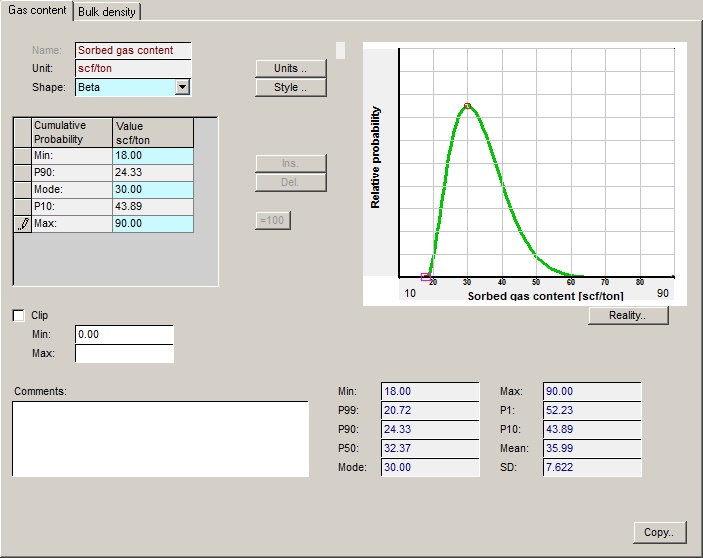
In REP, you can either enter sorbed gas content, or the isotherm data and the correction factors. Since sorbed gas content is traditionally measured in scf/ton (ton being short in this context) you need also to enter the rock density to allow conversion to volumes
Choose how you want to define sorbed gas content
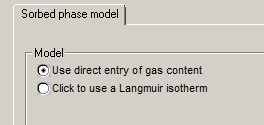
Direct entry of sorbed gas content |
Two distributions are entered: gas content and density |
Use a Langmuir isotherm, |
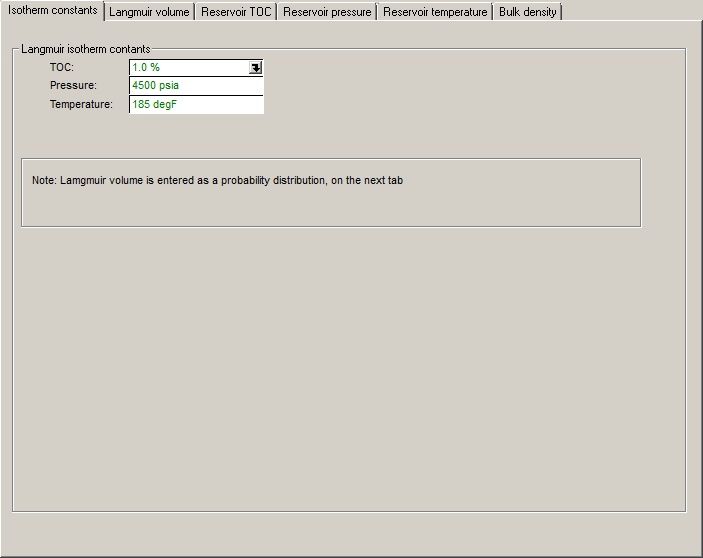
The isotherm constants are entered, along with reservoir TOC. pressure, temperature etc. |
Simple!
The isotherm constants are Langmuir volume, TOC, pressure and temperature. These all refer to the laboratory measurement and should really be single values. However, one core sample is not representative of the shale, so uncertainty in how well the sample (or sample) represent the reservoir is modelled by making the Langmuir volume a probability distribution.
The other parameters model the reservoir conditions, and so reflect how the reservoir differs from the lab sample and measurement in TOC, pressure, and temperature. Reservoir bulk density is required for conversion from scf/ton to bcf of sorbed gas.
Cynics observe that shale resource estimation is hugely uncertain, and that using isotherm data is over-science on the same scale.