Hydrocarbons |
  
|
Hydrocarbons |
|
This dialog consists of two tabs in which to enter the hydrocarbon type and options: Hydrocarbons and Fluids: options. Associated probability distributions are entered afterwards.
See 'Entering Probability Distributions' for help with Probability Distributions.
Prospects may be considered to contain oil, gas or both oil and gas. You need to define which, and how the prospect is likely to be filled. There are three basic reservoir hydrocarbon types: Oil, Gas and Gas condensate.
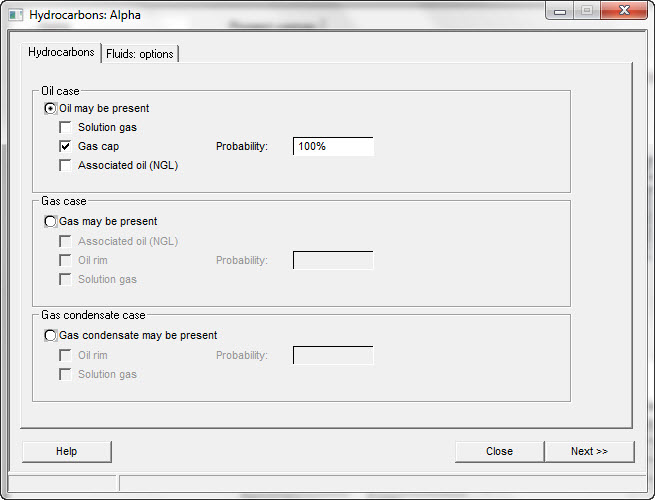
Oil reservoirs can have a gas cap. Gas and gas condensate reservoirs can have an oil rim. (There is no difference between an oil reservoir with a gas cap and a gas reservoir with an oil rim, though the former may be more management-friendly.)
Given a particular primary hydrocarbon type, you can assign a chance that the secondary hydrocarbon (gas cap or oil rim) is present.
With any oil volume you can additionally calculate an associated gas phase ("Solution gas"), and with a gas volume an associated liquids phase ("Associated oil (NGL)"). You can also account for the presence of inert gas.
Gas condensate is treated as a gas in the reservoir, and produces dry gas and liquids at surface. See below for alternative methods to estimate the liquids produced.
Oil case |
|
Oil may be present |
Check if oil is - or may be - present |
Solution gas |
Check to report solution gas in the oil phase |
Gas cap |
Check if there may be a gas cap |
(Gas cap) Probability |
Enter the probability of there being a gas cap |
Associated oil (NGL) |
Check if you wish to define NGL derived from the gas |
Gas case |
|
Gas may be present |
Check if gas is - or may be - present |
Associated oil (NGL) |
Check if you wish to define NGL derived from the gas |
Oil rim |
Check if there may be an oil rim |
(Oil rim) Probability |
Enter the probability of there being an oil rim |
Solution gas |
Check if you wish to allow solution gas from the oil-rim oil |
Gas condensate case |
|
Gas condensate may be present |
Check if gas condensate is - or may be - present |
Oil rim |
Check if there may be an oil rim |
(Oil rim) Probability |
Enter the probability of there being an oil rim |
Solution gas |
Check if you wish to allow solution gas from the oil-rim oil |
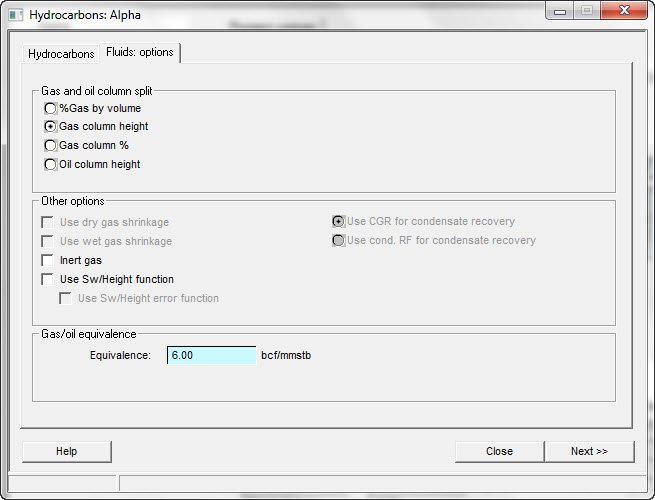
Gas and oil column split |
|
Gas and oil column split |
Specify in what way you would like to present the gas and oil column split. This is only relevant where there are both oil and gas phases present: oil with a gas cap or gas/gas condensate with an oil rim Specifying the split depends on how you have described the GRV: ·If you have entered GRV as a single distribution or as the product of area, thickness and shape factor then the only option available is to enter the amount of gas as a percentage of the total hydrocarbon-filled volume. This can be rather hard to estimate! ·If you are calculating GRV from area/depth data you can enter the percentage of gas as above; or you can enter the gas column height or oil rim height (in feet or metres), or the gas column height as a percentage of the total hydrocarbon column. |
|
|
Other options |
|
|
Use wet gas shrinkage |
You can optionally apply shrinkage factors to gas and gas condensate phases. Shrinkage is a multiplier applied to the gas phase at the surface, and relates the gas recovered to the gas sold, the difference being one or more of further liquids extraction, fuel gas, gas compression usage etc. There are different shrinkage factors for "ordinary" gas and gas condensate. Shrinkage is usually small - a few percentage points of gas taken out (so the REP entry will be close to 100%). In most cases it can be ignored. |
Use CGR for condensate recovery or Use cond. RF for condensate recovery |
These entries control how the liquids recovery is determined in a gas condenate reservoir. See 'Gas Condensate Reservoirs' below. |
Inert gas (usually nitrogen, carbon dioxide or hydrogen sulphide) can fill the pore space but does not contribute to the hydrocarbon reserve: ·Gas-in-Place = Net hydrocarbon pore volume x (100-%Inerts) x Gas expansion factor. ·Recoverable gas = GIP x Gas recovery factor. [Note: The gas expansion factor refers to the hydrocarbon gas (though getting this wrong is unlikely to make a significant difference in the context of REP).] |
|
Use Sw/Height function |
Using an Sw-height function can be important in reservoirs where there is a significant transition zone: tight reservoirs or structures with low relief. Using such a function can have a dramatic (and only too real) effect on volumes. Check the box if you want to use one. Entry of the function itself is described in the 'Water Saturation Height Functions' section. Sw-height functions can only be applied if you are calculating GRV from area/depth data. |
Use Sw/Height error function |
You can choose to use an error function on the Sw calculated from the function. Check the box, and enter the error function later, as a probability distribution. |
Gas/oil equivalence |
|
Equivalence |
If any of the product phases is a gas, you should enter a gas-oil equivalence factor (in mmstb/bcf). This factor is used when calculating the barrels-of-oil-equivalent. Ideally, gas-oil equivalence should be done on the basis of value, or perhaps energy equivalence, and so should vary slightly from field to field. But in practice most companies use a fixed value for all their assets. (So, strangely, the gas-oil equivalence does vary from field to field, but this variation is determined by accountants rather than petroleum engineers.) In 'User Options' you can specify this global equivalence factor and whether you wish to apply it always. If so, the factor you enter here is not used (though it is stored on file, and will be used if you switch off the global use). |
The way the program works out the actual volumes of oil and gas mimics - in a way - the charge and leakage process. In any iteration, the program chooses a spill point and a gas column height and therefore a notional gas-oil contact (GOC). If the spill point is above this GOC, the volume of gas is the volume down to the spill point and there is no oil. If the spill point is below the GOC, the volume of gas is that down to the GOC, and the volume of oil is that contained in the vertical interval between the GOC and the spill point. In other words, the program "leaks off" hydrocarbon from below, which is of course what happens geologically if you assume that leakage is post-charge.
In gas condensate cases, gas is considered the primary phase ("wet gas") and oil the associated phase.
Given a volume of wet gas in place, the wet gas expansion factor (1/Bg) and the wet gas recovery factor determine the amount of gas that is recovered.
There are two ways to specify the liquids produced:
1. Use CGR for condensate recovery: you enter a liquids yield (CGR or condensate/gas ratio). This should be a field average value, over the lifetime of the field. In order to calculate an equivalent "oil-in-place" you must also enter an initial liquids yield. This is a single number not a distribution, and its only purpose is to allow the program to work out (and report) this technically rather dodgy number. It also serves as a reminder to those unused to the complication of gas condensate predictions that the initial liquids yield (as reported, for example, in a drillstem test summary) is rarely - if ever - the field life average, which in almost every case will be much lower. To reinforce this point, the program checks that the initial yield is greater than the P10, the field average yield.
2. Use cond RF for condensate recovery: you enter an initial liquids yield and a liquids recovery factor (cond RF), both as probability distributions.
In the second case, the condensate-in-place is reported on the summary output forms; in the first case it is not.
You must enter probability distributions for the formation volume factors of oil, gas and gas condensate. Formation volume factors define the relationship between the volumes REP reports as recoverable, and the downhole volumes it calculates for each phase present. Gas/oil ratios (or liquids yields) are used to calculate the volumes of associated phases. The ratios or yields are always expressed as a ratio of "recovered" (i.e. reported) volumes.
Note: Often the formation volume factors and gas/oil ratios will be similar if not identical to those reported, for example, in DST or PVT reports. But, especially in gas condensate cases, they may not be. REP has no provision to simulate separation facilities, fuel gas requirements, equation-of-state models or any other of the sophisticated processing that will be part of a final development scheme. It is up to you to satisfy yourself that the combination of recovery factors, formation volume factors and GORs adequately represents the amount and distribution of recovered hydrocarbons.
The oil formation volume factor (Bo) is specified as a number greater than one, which is the way it is invariably reported. The program will automatically divide by Bo rather than multiply by it in the calculations. Note that this is one of the two obvious occasions in REP when the minimum value corresponds to the best reserve case (the other being Sw).
If you told the program that you wish to calculate a gas phase associated with the oil you must enter a gas/oil ratio. This is the ratio of "recovered" dry gas to "recovered" oil. In many field cases, the gas/oil ratio is not constant throughout the life of the field. Since the program is not a reservoir simulator you should enter the average gas/oil ratio over the full field life.
The gas formation volume factor (or more properly the gas expansion factor) 1/Bg is also entered as a number greater than 1.
If you told the program that you wish to calculate an oil phase (condensate) associated with the gas you must enter a liquids yield (or oil/gas ratio). This is the ratio of "recovered" dry oil to "recovered" gas. As with GOR above, this number must represent the average yield over field life.
See 'Fluid Correlations' for more information.