Area Uncertainty |
  
|
Area Uncertainty |
|
See also 'Gross Rock Volume' and 'Entering Probability Distributions'.
Area uncertainty should be used when the GRV calculations are from an area/depth table (probably from a digitized map).
This diagram shows how area uncertainly works, in comparison to the other uncertainties in GRV (which are mapping shifts and spill point/hydrocarbon contact.) It is the uncertainty in area for a given contour depth. It is expressed as a percentage error.
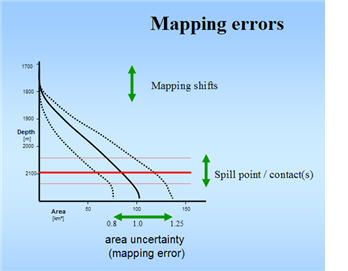
The area uncertainty distribution will usually be symmetrical, with a mean value of 100%. It need not be symmetrical and if it is not then there will be a consistent bias in the calculated GRV, compared to the GRV derived from the area/depth table numbers.
Beta and normal shapes are commonly used.
The spread of the distribution depends on the quality of the mapping - basic data quality, whether it is 2D or 3D, integrity of depth conversion and so on. No doubt the skill and track record of the interpreter should also be considered.
As a rule of thumb, maps based on good quality 3D data will have an area uncertainty P90 - P10 of 90% - 110%. If the data are poor, then this may increase to 80% - 120%. 2D data can be 70% - 130% or more.
Faced with a map (and especially if you did not make it yourself) the tendency is always to believe it more than you should do. You need to talk to the people who created it and get them to talk you through its strengths and weaknesses.