Consolidation type |
  
|
Consolidation type |
|
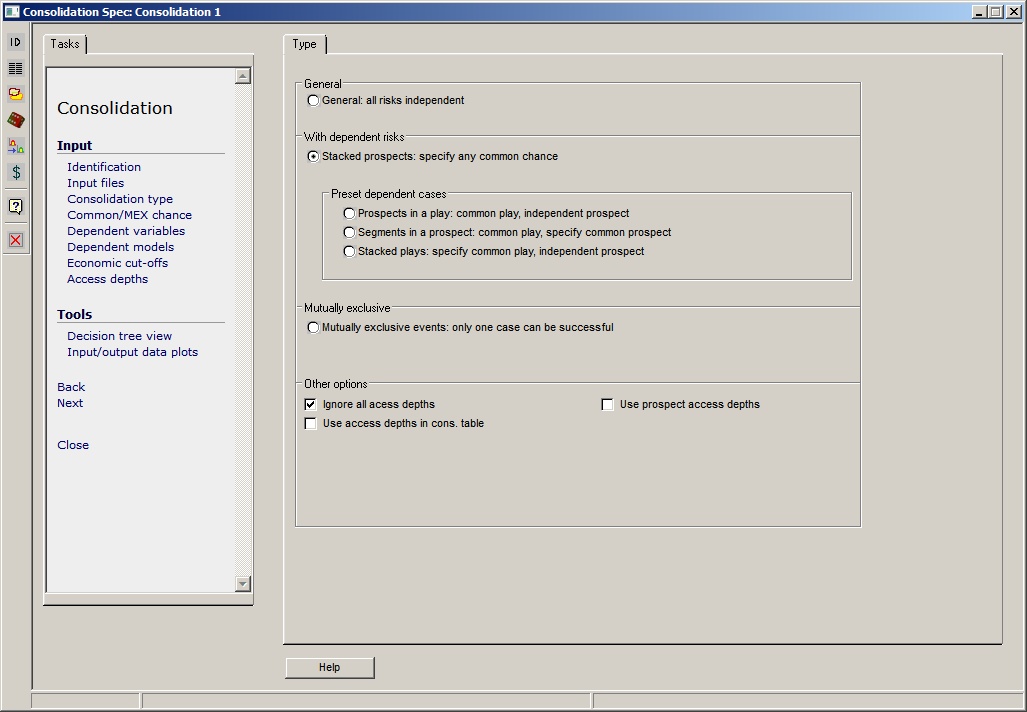
There are six forms of consolidation:
·General
·Stacked prospects
·Prospects in a play
·Segments in a prospect
·Stacked plays
·Mutually exclusive events
[Note: You should understand the meaning of 'Common risk' before going much further.]
Apart from mutually exclusive events, the consolidation types differ only in what elements of risk are considered common to all inputs.
General |
|
General |
There is no dependent risk. |
With dependent risk: |
|
Stacked prospects |
Any risk element may be made common. This is the most flexible type and is recommended. |
Prospects in a play |
All the play risks are common, and all the prospect specific risks are independent. You cannot change any dependency. |
Segments in a prospect |
All the play risks are common, but you can make any one of the the prospect specific risks common or not. |
Stacked plays |
All the prospect specific risks are independent, but you can make any element of the play risk common. This form of consolidation is only rarely useful. |
Mutually exclusive |
|
Mutually exclusive events |
See below. |
|
|
Access depths |
|
Ignore etc. |
Where you prospects have aspect depths (access depth is the depth at which the target is expected to be penetrated) you can choose to ignore them, use the depth specified in the prospect file of use depth tabulated in the consolidation access depth table. |
Usually (and unless you are using mutually exclusive events), the question is: do the input prospects share any risk element? If not, use a "general" consolidation. If they do, use "Stacked prospects" and enter the dependent risk elements in the next dialog.
Mutually exclusive events are items in a list of outcomes only one of which can occur. For example, if you throw a dice once, the result can be any number between one and six; but you can only get one of them.
Mutually exclusive events are almost always better handled by Prospect models. Only read on if you are sure that using prospect models is not appropriate.
In REP, a typical use of mutually exclusive events is in a case where you do not know whether a prospect contains oil or gas. You can work up two prospect files, one oil case and one gas case. Then you can consolidate them as mutually exclusive events, assigning relative probabilities to the two outcomes - for example, 60% chance of oil and 40% of gas.
Defining a consolidation of mutually exclusive events is exactly the same as defining a general consolidation except that at the end you must define the relative probabilities. The relative probabilities must add up to 100% (in fact, the program will adjust them so that they do anyway).
You can enter any number of different events - you could extend the oil or gas consolidation to include possible gas-condensate of two phase outcomes.
In general, mutually exclusive events are designed to take into account fundamentally different models of the same field or prospect. Besides the hydrocarbon type problem, you could use it to evaluate different development models (natural depletion or water injection, for example), or even different geological models. In this last case, you have to be very careful not to muddle up the chances of different models with the particular chances of success of individual models.