Prospect Risking Schemes |
  
|
Prospect Risking Schemes |
|
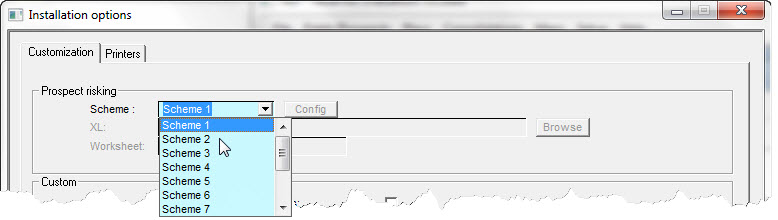
REP has a number of alternative risking schemes that you can use. However, all share the same basic concept: the overall chance of success of a prospect is divided into the two main categories of play chance and prospect specific chance.
The risking scheme you want to can be specified in the 'Site Customisation Section' (User Options | Installation). The way a prospect is risked is generally a matter of corporate policy if you are working in a corporate environment you will probably not need/want/be allowed top experiment with different risking schemes.
In some schemes, the categories of play and prospect risk are themselves divided into elements. For example, reservoir chance can be divided into presence and effectiveness. When it comes to calculation of the final risk in each element there are two commonly used methods:
·In a "multiplicative" scheme all the chance elements in each category are multiplied together to get the final category risk.
·In a "minimum risk" scheme the category risk is the minimum of all the element risks.
Strictly speaking, minimum risk schemes are a bit dodgy. They are a practical - if inelegant - way to overcome the perceived problem of over-risking a prospect.
In all schemes, the final chance of success ("GPOS") is the multiplication of all the risk category chances.
Here is a brief description of each scheme currently implemented in REP:
·Scheme 1 is a basic scheme in which the play risk has three elements: Reservoir, Seal and Source; and the prospect specific risk has four elements: Trap, Reservoir, Seal and Migration. The overall chance of success is the seven chances multiplied together.
·Scheme 2 has a single value for play chance. The prospect specific chance is divided into three sections: Reservoir, Trap and Source. Each of these elements is described by Presence and Effectiveness and you assign a probability to each. Only the lowest probability is used. So, if you give reservoir presence a chance of 0.8 and reservoir effectiveness a chance of 0.75, the actual reservoir chance used in the calculations will be 0.75. The overall chance of success is the play chance and the three prospect specific chances multiplied together.
·Scheme 3 is the same as Scheme 1 in that there are three categories of play risk and four categories of prospect specific chance. However, you can give each category your own name and you can also link probability ranges with names. For example, you can label probabilities between 25% and 50% "Possible" and below 25% as "Risky". The overall chance of success is the seven chances multiplied together.
·Scheme 4 has three categories of play risk: Reservoir, Seal and Source; and three of prospect specific risk: Trap, Reservoir and Migration. There are two additional risks: Model risk and Phase risk. The overall chance of success is the eight chances multiplied together.
·Scheme 5 has no play risk. The chance of success is divided into four categories: Trap, Seal, Reservoir and Hydrocarbon Charge. In each category a number of "conditions" or "considerations" are presented and you are invited to assign a probability that the condition is satisfied. The condition with the lowest probability is the controlling one and this gives the category its chance of success. The overall chance of success is the four chances multiplied together.
·Scheme 6 has three categories of play risk: Reservoir, Seal and Source; and five of prospect specific risk: Trap, Reservoir, Seal, Migration and Timing. The overall chance of success is the eight chances multiplied together.
·Scheme 7 is XL-based. Please e-mail us if you are interested in this option.
·Scheme 8 is "Q&A" based, like Scheme 5. There are three categories of play risk and four of prospect specific. Each category has several questions to which the answer is a chance expressed numerically but linked to a named answer (e.g. 70% equates to "likely"). In each category, the answer with the lowest chance is used as the chance for the category, a so-called minimum risking scheme.
·Scheme 9 has three categories of play risk: Reservoir, Seal and Source; and four of prospect specific risk: Trap, Seal, Reservoir and Hydrocarbon Charge. The overall chance of success is the seven chances multiplied together.
·Scheme 10 is similar to Scheme 9 but with only three categories of prospect specific risk: Trap, Reservoir and Hydrocarbon charge.
·Scheme 11 is again similar to Scheme 9 except that it includes a model risk and six categories of prospect specific risk (charge is split into Source, Migration and Timing).
·Scheme 12 is again similar to Scheme 9, however there are some differences to the questions. It has three categories of play risk: Reservoir, Seal and Source; and three of prospect specific risk: Trap, Reservoir and Hydrocarbon Charge. The overall chance of success is the six chances multiplied together.
·Scheme 9 with trap play risk (#15) has four categories of play risk: Trap, Reservoir, Seal and Source; and four of prospect specific risk: Trap, Seal, Reservoir and Hydrocarbon Charge. The overall chance of success is the eight chances multiplied together.
·Scheme 16 is a minimum risking scheme similar to 8, with the addition of an amplitude modifier.
·Scheme 17 is another minimum risking approach, also with an amplitude modifier.
·Scheme 21 is a minimum risking approach, with an amplitude modifier.
·Schemes 22 and 24 are multiplicative schemes using only 6 elements: presence and effectiveness of trap, reservoir and source. The difference between the two is in the questions.
·Scheme 23 is multiplicative, with five prospect specific categories: reservoir, seal, structure, charge and recovery.
·Scheme 25 is multiplicative, with five prospect specific categories: source, reservoir, trap, migration and seal. There are no questions, you enter comments for all entries.
·Scheme 26 is a minimum risking scheme similar very similar to 16.
·Scheme 28 is the same as scheme 9 but with added amplitude modifier and confidence data/plot